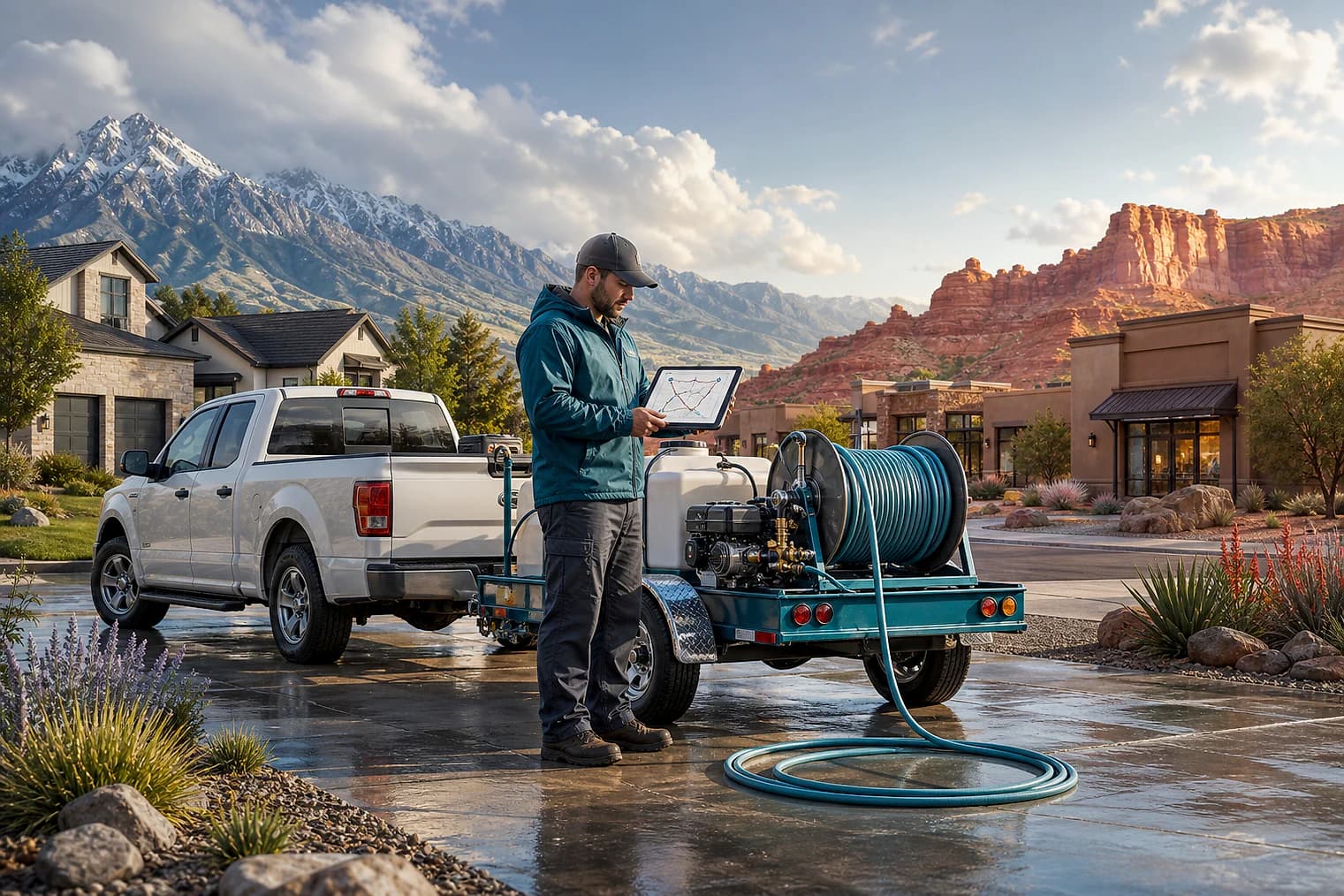
The forecast is a lead list, not the advertisement
The first warm-looking weekend after a Wasatch winter is not merely a production window. It is a sales signal: owners can suddenly see the traffic film, salt, and neglected concrete they stopped noticing in January. The expert move is to market one window earlier—when estimates can be grouped, expectations set, and suitable work queued—not to promise that one sunny icon makes every surface ready.
Utah refuses a single campaign calendar. NOAA's 1991–2020 station normals put Salt Lake City International Airport's July daily maximum at 94°F and average 111.7 days a year with a minimum at or below freezing. St. George's July normal maximum is 101.9°F, with 128 days reaching at least 90°F. Those are climate normals, not job forecasts. Their marketing lesson is narrower and stronger: sell Cache Valley, the Wasatch Front, and Washington County on their own clocks.
Own a real map before renting a bigger one
For local search, accuracy is a growth strategy. Google's current guidance says local results mainly turn on relevance, distance, and prominence, and that complete, accurate information helps a business appear for relevant searches. Its service-area rules generally allow a mobile operator one profile for the real central location, require the home address to be hidden when customers are not served there, and reject virtual offices. Ten invented city offices are not a Utah expansion plan; they are a suspension risk.
Build the public proof around work you can actually route. A useful page answers one buyer's question—what happens to this surface, in this area, under these access and water conditions—with an approved dry-result photo and a clear next step. Forty thin city pages saying the same thing cannot substitute for fast replies, specific scopes, current hours, and evidence from real service territory.
One good job should create five marketing assets
After the surface dries and the customer accepts the result, the job can produce more than an invoice: an approved before-and-after pair, a short case note about the material and constraint, a uniform review request, a reason to contact nearby prospects, and a dated reminder for sensible follow-up. Strip addresses, names, access codes, and identifying property details from public material. Show the problem, control, and result—not the customer's life.
Ask every genuine customer for an honest review through the same no-incentive process. Google permits review links and QR codes but prohibits incentives for posting, changing, or removing reviews; the FTC separately prohibits fake reviews and incentives conditioned on sentiment. Then build density around the proof. USPS's Every Door Direct Mail tool can select carrier routes without a name list. The tactic is not 'mail all Utah.' It is: finish well, prove it, and make the next short drive easier to win.

Weather belongs in the denominator, not on a fake surcharge
Weather changes production twice. First it changes today's work: a hot surface can shorten a wet window, a gust can defeat spray control, and a freeze can remove a route from the schedule. Then it changes annual capacity—the hours a rig and trained crew can responsibly sell. OSHA warns that an airport report or Heat Index can miss direct sun, hot surfaces, workload, clothing, and blocked wind at the site.
Do not turn that uncertainty into a mysterious 'Utah weather fee.' Estimate workable hours by season, move suitable jobs into early or sheltered windows, state stop and reschedule terms, and update production assumptions from completed work. Market only the slots the operation can protect. A smaller honest calendar converts better than a week of apologies disguised as leads.
Different lead engines need different price floors
A one-person shop can win with a tight map, owner response, and neighborhood proof; it should protect an owner-day and mobilization minimum. A small team needs enough route density to keep paid crew-hours productive. A franchise must start with those same Utah job economics, then load the actual royalties, advertising contributions, technology costs, supplier rules, and discounts in its disclosure and agreements. A large team should manage contribution by service line, route, and promise—not hide everything inside one square-foot rate.
The categories overlap; the costs do not vanish. Utah's Labor Commission says employers generally must provide workers' compensation for employees, while some owner-only situations differ. The FTC points franchise buyers to FDD Items 5–7 for initial and continuing costs and Item 11 for advertising programs. An owner wage, an employed crew, an ad fund, and a regional sales team are not comparable until all four reach the cost sheet.

Stop measuring applause; measure the trip to gross profit
The SBA's marketing guidance ties target market, competitive advantage, channels, pricing, budget, and return on investment into one plan. For a mobile cleaner, the useful chain is source → qualified lead → inspected scope → quote → booked job → dry acceptance → gross profit after acquisition. Likes and raw form fills are observations, not outcomes.
Read that chain by service and territory. Track response time, quote rate, win rate, acquisition cost per won customer, revenue and contribution per crew-hour, empty travel, reschedules, callbacks, repeat work, and referrals. A cheap lead from Tooele can be expensive for an Ogden route; a modest postcard response can be excellent when three neighbors fit beside work already sold.
Build the offer backwards from a dry, accepted result
Use one operating sheet for the marketing promise and the estimate. It should answer these five questions before more money goes into the channel:
- Who has this exact surface problem in a territory the crew can serve densely, and what weather signal makes the timing relevant?
- What approved photo, review, method, credential, or case evidence proves the promise without exposing a customer or overstating a result?
- What will loading, travel, protection, testing, production, recovery, inspection, selling, and follow-up consume?
- After realistic seasonal capacity, owner or crew pay, overhead, acquisition cost, and any gross-sales fees, what is the price floor?
- Which source produced the job, what did it contribute after completion, and should the next dollar repeat, refine, or stop that campaign?
The best forecast belongs in the business, not the slogan
Utah customers do not need a contractor pretending to command the weather. They need one who sees the next problem early, explains the work clearly, arrives with the right controls, and prices enough resilience to keep the promise. The memorable marketing is not 'we wash everything, everywhere.' It is the calm proof that this company knows which job, which window, which route, and why.