A new draft opened; the field rule did not change
On August 3, all 10 EPA regions proposed the 2027 National Pollutant Discharge Elimination System Construction General Permit. If finalized, the five-year permit would replace EPA's current 2022 construction permit when that permit's term ends in February 2027. EPA's proposal page now lists September 17 as the comment deadline, superseding the September 2 date printed in the original Federal Register notice.
The proposal has no present field effect. EPA's current permit and every applicable state, Tribal, local, and site requirement remain in place. EPA's summary focuses proposed changes on subjects including water-quality language, public access to a site's stormwater pollution prevention plan, sediment basins, stabilization, and turbidity reporting.
The wash-water passages reviewed for this article are carried forward from the current federal permit. Comparing Parts 1.2.2, 1.3, and 2.3.2 of the two documents shows no new general authorization for commercial washing. The news is a replacement permit proposal—not federal approval to route ordinary wash water through a construction site.
Read coverage before reading the wash clauses
The proposed permit covers eligible operators of construction sites in places where EPA is the NPDES permitting authority. The ordinary threshold is construction activity disturbing at least one acre, including a smaller parcel within a common plan that will ultimately disturb at least one acre; EPA can also designate other discharges for coverage.
Under the draft definition, an operator controls construction plans and specifications or the day-to-day activities needed for permit compliance. It says subcontractors generally are not operators. A washing subcontractor therefore should not assume it owns the permit, and it cannot borrow coverage by copying one sentence from it. The project operator's active coverage, site-specific stormwater pollution prevention plan, and directions still have to fit the proposed task.
Not being the permit operator is not permission to ignore site controls. A contractor can still have contractual duties, receive instructions from the operator, and face other environmental or local requirements. Record who made the water-routing decision and which current authority and site document support it.
Three clauses do not make one blanket disposal route
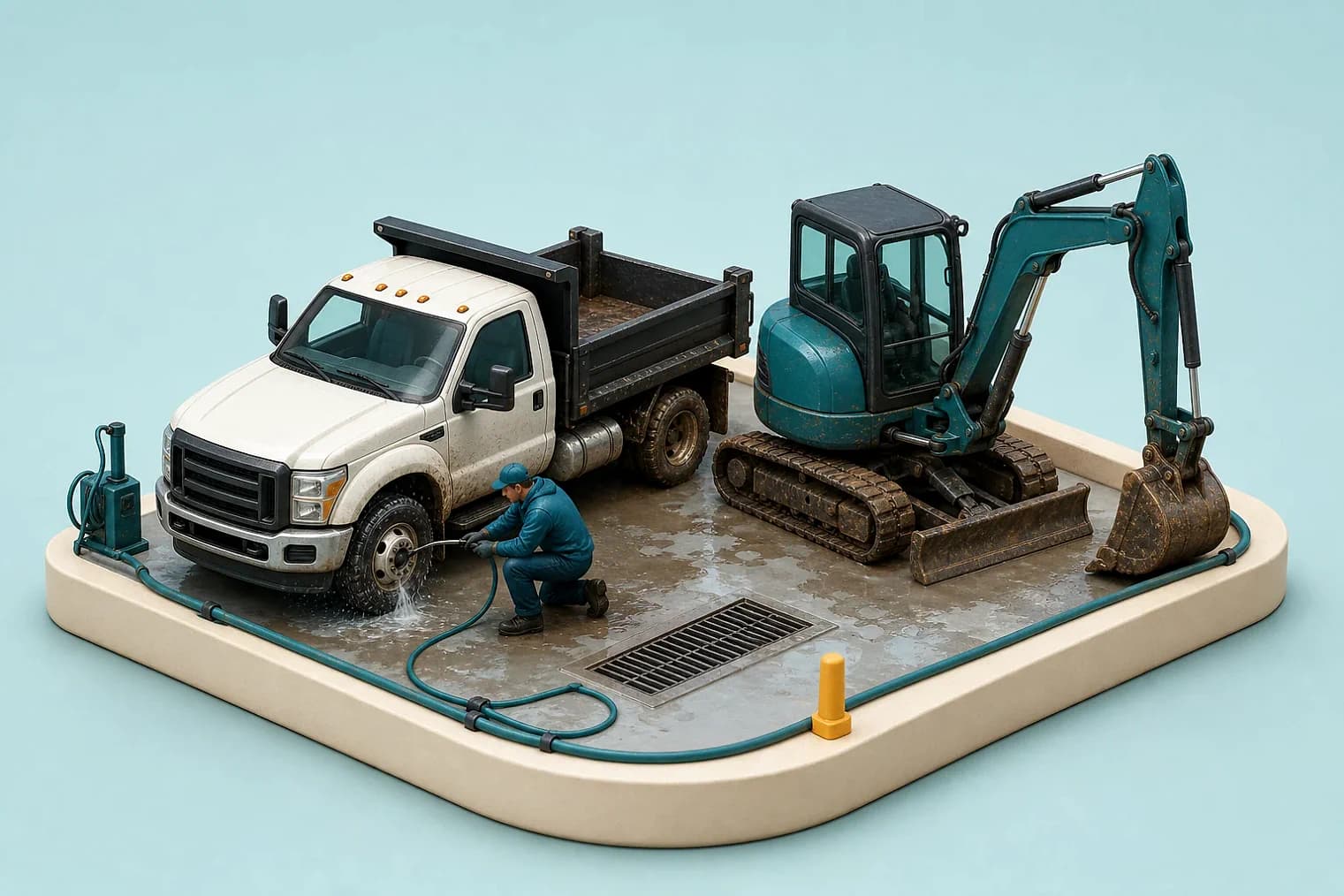
Draft Part 1.2.2 conditionally authorizes specified non-stormwater discharges associated with covered construction activity. Vehicle and equipment wash water may not discharge soaps, solvents, or detergents. External building washdown has the same product limitation and also excludes surfaces containing hazardous substances. Pavement wash water is limited to areas without toxic or hazardous spills or leaks, unless all spill material has been removed, and it also excludes soaps, solvents, and detergents.
The pavement clause prohibits directing that water into a receiving water, storm-drain inlet, or constructed or natural site drainage feature unless the feature connects to a sediment basin, sediment trap, or similarly effective control. The broader section also says these authorized non-stormwater discharges generally may not be routed to exposed soil and must comply with the permit's pollution-control and water-quality parts.
Other provisions close the shortcut further. The draft prohibits discharges of soaps, solvents, or detergents from vehicle, equipment, and external-building washing; construction-material washout and toxic or hazardous releases have their own prohibitions. It requires controls that minimize pollutants from equipment, vehicle, wheel, and other wash waters. A sediment control selected for soil is not automatically effective for oil, paint, cleaning chemistry, metals, or another site contaminant.
Put a construction-site release gate in the work order
- Identify the job address, land status, permitting authority, active permit number, named operator, and site stormwater contact.
- Obtain the relevant SWPPP controls and written site direction for this wash; do not rely on a generic permit excerpt or a verbal claim that the drain is approved.
- Inventory the exact vehicle, equipment, pavement, or building surface; historic spills; visible and expected soil; hazardous surface material; and every proposed product. Keep the current label and safety data sheet with the work plan.
- Trace water from the trigger through containment, treatment, recovery, transport, and final destination. Confirm that each control addresses the actual pollutants and that the responsible operator and authority support the route.
- Write a stop condition for changed drainage, unidentified residue, failed controls, unexpected chemistry, or a scope that does not match the permit and SWPPP. Recheck the federal proposal after final action before changing standard practice.