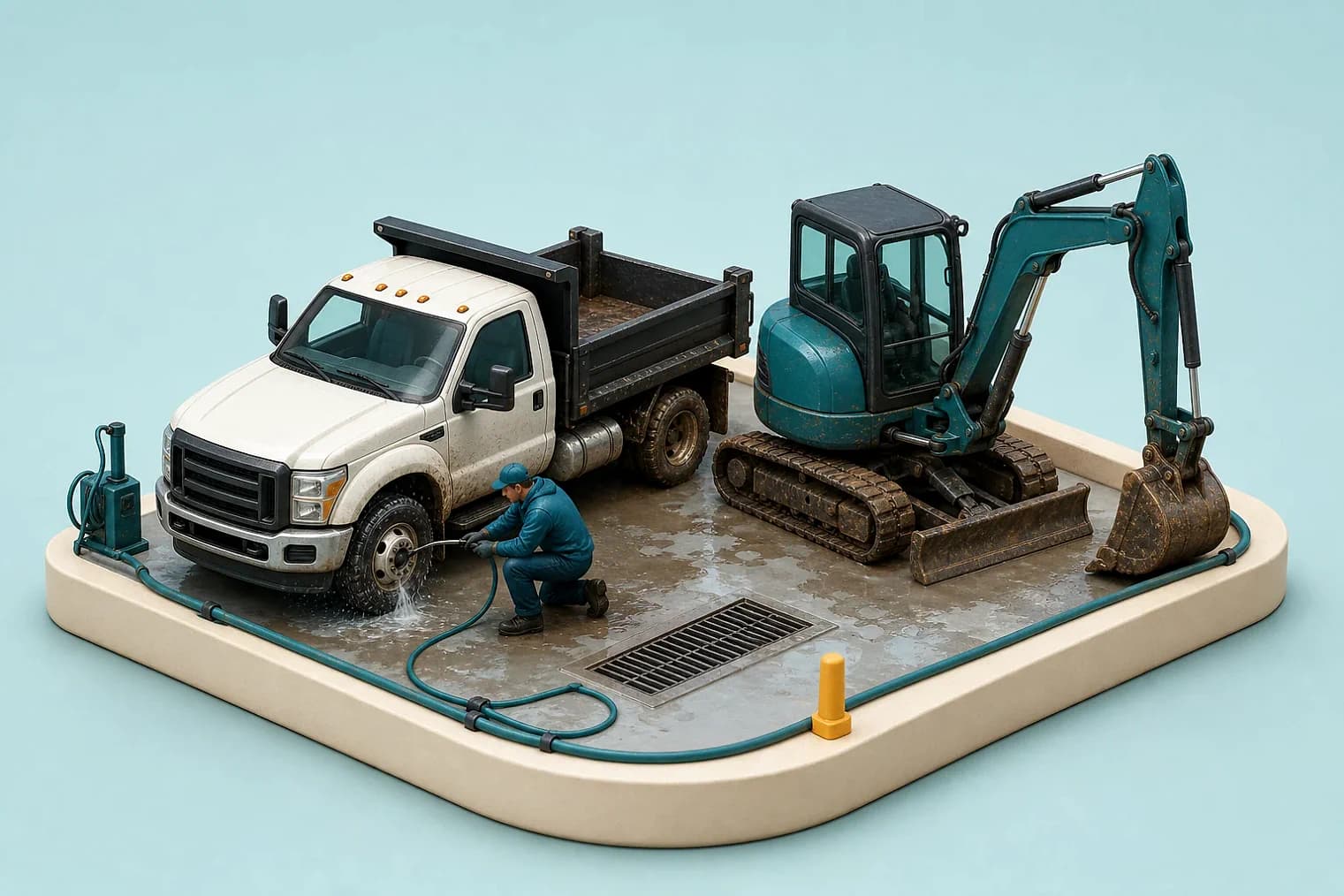
Trace water before choosing equipment
Walk the slope from the work area to every inlet, gutter, landscape edge, neighboring parcel, and waterbody. Ask the property contact for a utility or drainage map, but verify what is visible. A sanitary cleanout, storm inlet, oil-water separator, and landscaped area are not interchangeable destinations.
Utah's UPDES program controls stormwater discharges through municipal, construction, and industrial programs. Salt Lake City separately describes illicit non-stormwater discharges and high-risk commercial runoff. The correct contact can change with the jurisdiction and site.
Name what the water will carry
Dust and organic debris present a different disposal question from oil, heavy metals, paint chips, animal waste, degreaser, acid, sodium hypochlorite, or an unknown residue. Review the work surface, prior site use, product safety data, and any pre-treatment before deciding what to capture.
If the crew cannot characterize a residue, stop treating it as ordinary wash water. Escalate the question to the site owner and the authority that would receive or regulate the discharge.
Match controls to the failure path
- Dry clean and remove loose material before introducing water.
- Protect inlets and create containment before application begins.
- Use berms, drain covers, recovery surface cleaners, vacuums, or holding tanks sized for the expected flow.
- Plan for hose failure, a blocked vacuum, sudden grade change, wind, traffic, and rainfall.
- Keep a spill kit and a person assigned to watch containment while the operator cleans.
Recovery is only halfway to disposal
Salt Lake City's pretreatment program directs businesses that discharge—or may discharge—non-domestic wastewater from washing or cleaning to submit a Commercial and Industrial User Questionnaire. Its review can lead to discharge limits or a permit requirement. Other sewer systems have their own processes. Do not infer approval from a convenient drain.
Record the receiving authority, contact, date, waste description, approved route, limits, and any hauling or manifest requirement. If conditions on site differ from what was approved, pause and reconfirm.
Close the job with evidence
Retain the site sketch or photos, products and SDS references, estimated and recovered volume, containment inspection, disposal record, deviations, and customer sign-off. That record supports training and repeat work; it does not replace an applicable permit or professional advice.